Businesses can take several strategic steps to prepare for the intersection of AI and quantum computing:
- Education and Awareness:
- Training: Organizations should invest in educating their data scientists, engineers, and decision-makers about quantum computing and its implications for AI.
- Collaboration: Foster collaboration between AI and quantum experts. Encourage cross-disciplinary teams to explore potential applications.
- Assessing Use Cases:
- Quantum Advantage: Identify use cases where quantum computing could provide a significant advantage over classical methods. Examples include optimization problems, cryptography, and drug discovery.
- Hybrid Approaches: Explore hybrid quantum-classical models that leverage both quantum and classical resources.
- Infrastructure and Resources:
- Quantum Hardware: Stay informed about advancements in quantum hardware. While large-scale quantum computers are still rare, cloud-based quantum services (like IBM Q Experience) allow experimentation.
- Quantum Software: Understand quantum programming languages (such as Qiskit, Cirq, or Forest) and quantum algorithms.
- Data Preparation:
- Data Encoding: Quantum computers use qubits, which require specific encoding. Businesses should adapt their data to quantum-friendly formats.
- Noise and Error Mitigation: Quantum computers are noisy. Develop strategies to handle errors and noise in quantum computations.
- Algorithm Exploration:
- Quantum Machine Learning: Investigate quantum algorithms for machine learning tasks. For instance, quantum support vector machines or quantum neural networks.
- Quantum Annealing: Explore quantum annealers for optimization problems.
- Security and Cryptography:
- Post-Quantum Cryptography: Prepare for the day when quantum computers can break classical encryption. Adopt post-quantum cryptographic algorithms.
- Quantum Key Distribution: Explore quantum-safe communication methods.
- Investment and Partnerships:
- Start Early: Quantum computing is a long-term investment. Start exploring now.
- Collaborate: Partner with research institutions, startups, and quantum companies to stay at the forefront.
- Ethical Considerations:
- Bias and Fairness: As AI and quantum intersect, ensure fairness and transparency in algorithms.
- Privacy: Quantum computers could break classical encryption, impacting data privacy. Develop quantum-resistant encryption methods.
- Regulatory Landscape:
- Stay Informed: Monitor regulatory developments related to quantum technologies. Understand how they impact AI applications.
- Experimentation and Prototyping:
- Proof of Concepts: Run small-scale experiments and prototypes to understand the feasibility and limitations of quantum-enhanced AI.
- Quantum Cloud Services: Leverage cloud-based quantum platforms for testing.
Remember, the journey into quantum-enhanced AI is exciting but challenging. Businesses that prepare early and adapt will be well-positioned to harness the power of this fusion.
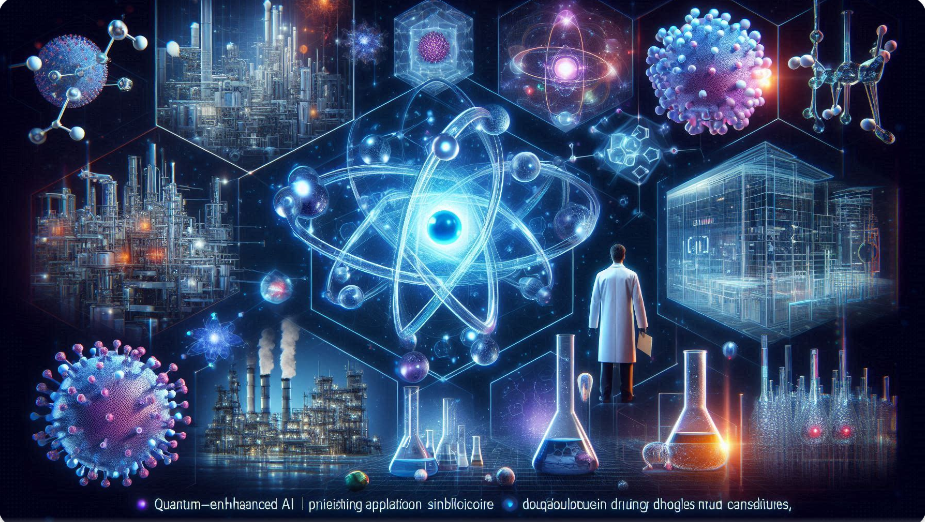
Further, Quantum-enhanced AI is an exciting frontier with promising applications across various domains. Let’s explore some real-world examples:
- Drug Discovery:
- Quantum computers can precisely simulate drug molecules, aiding in the identification of potential drug candidates. By understanding how these candidates interact with complex biological molecules, researchers can improve healthcare worldwide [1].
- Industrial Chemistry:
- Quantum simulations can optimize chemical processes, making them safer and more efficient. For instance, ammonia production contributes to global greenhouse gas emissions. Quantum-enhanced simulations could enhance ammonia manufacturing and reduce emissions [1].
- Sustainable Technology:
- Quantum computers provide detailed electrochemical battery simulations. This can lead to higher-performing batteries, faster-charging electric vehicles, and a greener energy grid with 24/7 renewable power supply [1].
- Finance:
- Quantum decision-making can revolutionize risk assessment and portfolio optimization in the financial sector [2].
- Healthcare:
- Quantum-enhanced AI has applications in personalized medicine and disease prediction [2].
- Logistics:
- Quantum algorithms can optimize route planning and supply chain logistics, improving efficiency and cost savings [3].
- Cybersecurity:
- Quantum cryptography promises secure communication channels, protecting sensitive data from quantum attacks [2].
Remember, as quantum computing continues to evolve, we’ll witness even more groundbreaking applications that bridge the gap between AI and quantum mechanics.
Source: